
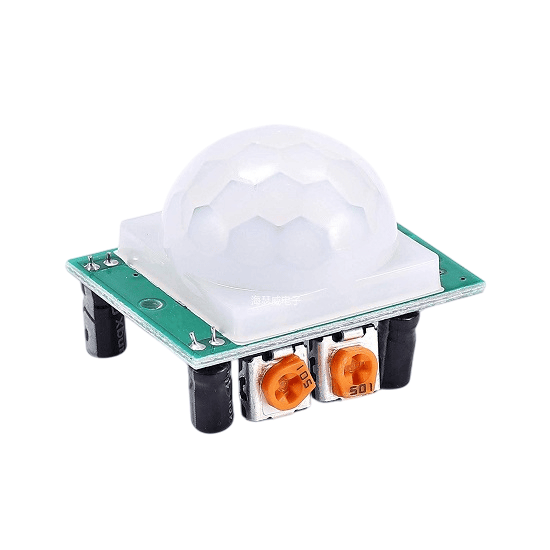
HC-SR501 - PIR Motion Sensor
Non-returnable
₹63.00
HC-SR501 - PIR Motion Sensor
Product Details
| Working Voltage Range: | 4.5V- 20V DC |
| Current Drain: | <60uA |
| Detection Range: | <140° |
| Voltage Output: High/Low level Signal: | 3.3V TTL output |
| Detection Distance: | 3 to 7m (can be adjusted) |
| Delay Time: | 5 to 200s (Can be Adjusted, Default 5s +/- 3%) |
| Blockade time: | 2.5s (Default) |
| Work temperature: | -20°C ~ 80°C |
| Dimension: | 3.2cm x 2.4cm x 1.8cm (Approx) |
| Sensitive Setting: | Turn to Right, Distance Increases (About 7M); Turn to Left, Distance Reduce (About 3M) |
| Time Setting: | Turn to Right, Time Increases (About 200S); Turn to Left, Time Reduce (About 5S). |
Key Features:
- Passive Infrared Sensor: The HC-SR501 is a passive sensor, which means it doesn’t emit any radiation itself but rather detects the infrared radiation emitted by objects in its field of view.
- Detection Range: It has a typical detection range of about 3 to 7 meters (10 to 23 feet) and a detection angle of approximately 110 degrees.
- Adjustable Sensitivity: You can adjust the sensitivity of the module using the onboard potentiometer. This allows you to fine-tune the module’s response to motion.
- Adjustable Time Delay: The module also features an adjustable time delay, which determines how long the output signal remains high after motion is detected. You can set this delay to suit your specific application.
- Output Signal: When motion is detected, the module provides a high-level (usually 3.3V or 5V) output signal on its output pin. This signal can be connected to a microcontroller or other devices for further processing.
How It Works:
- Infrared Sensing: The HC-SR501 module contains a pyroelectric sensor, which is sensitive to infrared radiation. When an object, such as a human or animal, moves within the detection range, it emits infrared radiation that the sensor can detect.
- Signal Processing: The module includes a signal processing circuit that amplifies and processes the sensor’s output. It also compares the current signal with the previous signal to detect changes, such as motion.
- Output Signal: If motion is detected, the module’s output pin goes high for the duration of the set time delay. This high signal can trigger an action, such as turning on lights, activating an alarm, or capturing images with a camera.